Engineering Mechanics - Friction
Why should I learn to solve Engineering Mechanics questions and answers section on "Friction"?
Learn and practise solving Engineering Mechanics questions and answers section on "Friction" to enhance your skills so that you can clear interviews, competitive examinations, and various entrance tests (CAT, GATE, GRE, MAT, bank exams, railway exams, etc.) with full confidence.
Where can I get the Engineering Mechanics questions and answers section on "Friction"?
IndiaBIX provides you with numerous Engineering Mechanics questions and answers based on "Friction" along with fully solved examples and detailed explanations that will be easy to understand.
Where can I get the Engineering Mechanics section on "Friction" MCQ-type interview questions and answers (objective type, multiple choice)?
Here you can find multiple-choice Engineering Mechanics questions and answers based on "Friction" for your placement interviews and competitive exams. Objective-type and true-or-false-type questions are given too.
How do I download the Engineering Mechanics questions and answers section on "Friction" in PDF format?
You can download the Engineering Mechanics quiz questions and answers section on "Friction" as PDF files or eBooks.
How do I solve Engineering Mechanics quiz problems based on "Friction"?
You can easily solve Engineering Mechanics quiz problems based on "Friction" by practising the given exercises, including shortcuts and tricks.
- Friction - General Questions

The boy at D has a mass of 50 kg, a center of mass at G, and stands on a plank at the position shown. The plank is pin-supported at A and rests on a post at B. Neglecting the weight of the plank and post, determine the magnitude of force P his friend (?) at E must exert in order to pull out the post. Take  B = 0.3 and C = 0.8.

A uniform beam has a mass of 18 kg and rests on two surfaces at points A and B. Determine the maximum distance x to which the girl can slowly walk up the beam before it begins to slip. The girl has a mass of 50 kg and walks up the beam with a constant velocity.
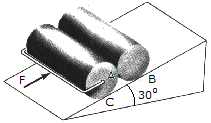
Determine the minimum force F needed to push the two 75-kg cylinders up the incline. The force acts parallel to the plane and the coefficients of friction at the contacting surfaces are A = 0.3, B = 0.25, C = 0.4. Each cylinder has a radius of 150 mm.

The refrigerator has a weight of 200 lb and a center of gravity at G. Determine the force P required to move it. Will the refrigerator tip or slip? Take = 0.4.

A 17-kg ladder has a center of mass at G. If the coefficients of friction at A and B are A = 0.3 and B = 0.2, respectively, determine the smallest horizontal force that the man must exert of the ladder at point C in order to push the ladder forward.